
Global Marketing Study — Personalized Beauty
This project was a global research initiative conducted to support the development and launch of a new personalized beauty care device. The study explored consumer behavior, routines, and perceptions across six international markets to identify the most promising target audiences and messaging strategies. By combining qualitative interviews with large-scale survey data, the research provided the client with a clearer understanding of how beauty routines, product expectations, and technology adoption varied across markets.
Role: Lead Researcher
Duration: 3 months
Outcome: Delivered a global mixed-methods research study across six international markets, identifying the most promising target audiences and messaging strategies for a new personalized beauty device. The research informed the client’s market entry strategy and product positioning for a phased global launch.
Details
Challenge:
A global consumer brand was exploring a new personalized beauty device, but lacked clarity on who the product should target and how it should be positioned across different markets. Beauty routines, technology adoption, and product expectations varied significantly between countries, making it difficult to develop a single global strategy. The challenge was to identify the most promising audiences and develop unique, individual messaging that would resonate for each of the six international markets. (USA, UK, China, South Korea, Brazil, and France)
Core questions to be answered:
Who are the most promising target audiences for this product across the six markets?
How do consumers currently approach their skincare routines, and what products or technologies do they use?
What emotional drivers, fears, and goals shape consumer behavior around personalized skincare?
How do cultural differences influence perceptions of beauty technology and device-based skincare?
How do consumers interpret the product concept, and what messaging resonates most strongly with each target group?
Responsibilities:
Coordinated research efforts across six international markets
Aligned methods across multiple research teams
Designed research frameworks and interview structures
Led qualitative synthesis and insight development
Collaborated with quantitative specialists
Research Methods:
Remote qualitative interviews
Large-scale quantitative survey
Deductive thematic coding
Mixed-method synthesis (qualitative + quantitative)
Week 1 — Kickoff & Alignment
Aligned with the client and research partner on business goals, target groups, research scope, and market coverage.
Week 2 — Research Design
Developed the interview framework, survey structure, and screening questionnaires for the three target groups.
Week 3 — Local Team Onboarding
Onboarded the six local research agencies and aligned on moderation expectations, research quality standards, and workflows.
Week 4 — Recruitment Launch
Local agencies began recruiting participants for both qualitative interviews and the quantitative survey using the shared screener.
Week 5 — Fieldwork Launch
Started qualitative interviews while also launching the quantitative survey across the markets.
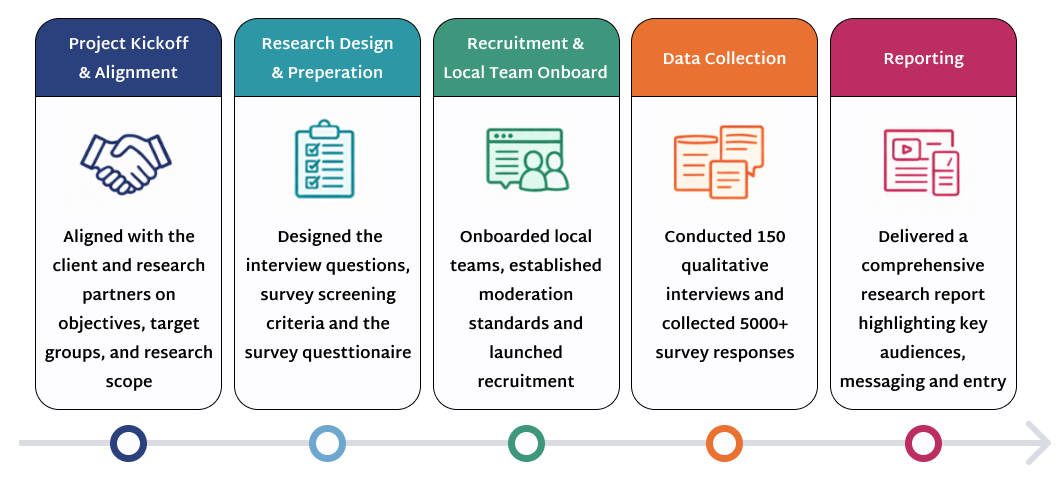
Timeline
Week 6–7 — Ongoing Data Collection
Continued both qualitative interviews and survey collection while monitoring research quality and reviewing early findings across markets.
Week 8 — Qualitative Coding & Early Synthesis
Conducted deductive coding of interview transcripts and notes to identify early behavioral patterns and themes.
Week 9 — Quantitative Synthesis
Analyzed survey data to identify statistical patterns across markets and validate qualitative findings.
Week 10 — Mixed-Methods Synthesis
Combined qualitative insights and quantitative results to identify key audiences, messaging opportunities, and market differences.
Week 11–12 — Report Development & Recommendations
Developed the final research report outlining target audiences, messaging frameworks, and strategic recommendations for a phased product launch.
Deep dive into research approach
Qualitative Research
The qualitative portion of the study consisted of 150 in-depth remote interviews conducted across the varioius markets. Interviews were moderated by local research teams in each country to ensure cultural nuance and language accuracy.
The interview structure followed two main phases:
Understanding routines and motivations
Participants were first asked to walk through their daily skincare routines, including the products they used, why they used them, and how they evaluated product effectiveness. This helped reveal behavioral patterns and emotional drivers behind skincare decisions.
Product perception and concept interpretation
In the second stage of the interview, participants were introduced to the product concept. Rather than asking whether they liked the product, we focused on how they interpreted it—what they believed it did, what associations the name created, and what emotions or expectations it triggered. This approach helped surface language patterns and marketing cues that could inform product positioning.

Quantitative Research
To validate and scale the insights gathered from the interviews, we conducted a large-scale survey with more than 5,000 participants across the same six markets.
The quantitative survey was designed to mirror the structure of the qualitative interviews, allowing us to test patterns identified during the interviews at scale. Many of the questions in the survey reflected the same themes explored during the interviews, including beauty routines, product usage, attitudes toward personalization, and use of technology-driven skincare solutions.
This approach allowed us to identify statistical patterns across markets and target groups, strengthening the reliability of the insights, and compare/contrast them with our qualitative learnings.
Impact and Outcome
The research provided the client with a clearer understanding of how consumer behavior, product expectations, and technology adoption varied across six international markets. By using a mixed-metholody approach, we were able to combine qualitative insights with large-scale survey data, the study identified the target segments most likely to adopt a personalized beauty device and highlighted key cultural differences that would influence product perception and market success.
One of the most important findings was that the product showed strong potential in only a subset of the markets studied. Based on these insights, we recommended a multi-phased market entry strategy, prioritizing countries where consumer behavior, product understanding, and cultural attitudes toward beauty technology aligned most closely with the product concept.
The final research report delivered a strategic framework that included target audience profiles, messaging recommendations, and market positioning across all six countries. These insights helped the client refine their positioning and develop a clearer strategy for introducing the product internationally.